Apart from mortgages, every deed recorded on Martha's Vineyard first goes through the Martha's Vineyard Land Bank. The Land Bank charges a 2% fee on real estate transfers in all six towns, and the buyer pays it at closing. Under the Land Bank's enabling law, the Registry cannot record a deed, other than a mortgage, until the Land Bank certifies that the fee was paid or that the transfer is exempt.
On a $4 million Chilmark purchase, 2% comes to $80,000. Few other closing costs match that amount, and there is usually no way to negotiate it down. The main exemption in the law is written for first-time buyers who make the home their domicile.
The Exemption That Rarely Fits a Second Home
The Land Bank's current exemption affidavit, Form LB2, exempts the first $1,000,000 of the purchase price under subsection (m). Three conditions apply:
- The buyer, and the buyer's spouse if there is one, must never have owned or held any real property interest, inside or outside Dukes County.
- The buyer must make the property their actual domicile within two years, "with the intention to remain permanently or for an indefinite time."
- If the property is resold within five years, the exempted fee becomes due with interest and penalties. A lien securing that amount runs with the land in the meantime.
The first condition covers prior ownership anywhere, and the second requires the property to become the buyer's domicile. As written, these conditions describe a first-time buyer moving to the island, so for many purchases at Chilmark's high end the fee is calculated on the full price. For a transfer that does not qualify for an exemption, the Land Bank's processing instructions ask for a check equal to 2% of the purchase price.
The other exemptions in the statute cover transfers that are not market sales. They include gifts, trust distributions, transfers at death or in bankruptcy, partitions, foreclosures, divisions of marital assets, transfers to government bodies, and certain transfers to charitable or religious organizations. If the buyer is the seller's spouse, lineal descendant or lineal ancestor and pays less than fair market value, the statute presumes a gift only for the difference between the price and the value. In March 2026, the Land Bank also added an exemption for homes with permanent affordable-housing restrictions and resale controls. Its affordable housing policy shows amendments through March 23, 2026. Fred Khedouri, Chilmark's member of the Land Bank commission, wrote to the commission that the change would have "minimal impact on revenues," according to the Vineyard Gazette.
All of these exemptions explain a gap in the weekly numbers. For the week ending Oct. 30, 2026, the MV Times registrar's report counted 31 transactions and $323,801 in fees. The Gazette's town-by-town breakdown for the same week lists nine fee-paying transactions: four in Edgartown, three in Tisbury, one in Oak Bluffs and one in West Tisbury. Every deed goes through the Land Bank and is counted, but only market sales that do not qualify for an exemption pay the fee. A market-rate Chilmark sale to a second-home buyer typically falls in that group.
What the Ledger Shows About Chilmark
The Land Bank's weekly revenue is published, so the fee also gives a near-real-time view of where money is changing hands. In 2026, Chilmark shows up in that record only occasionally, and some of its weeks are very large.
| Week ending, 2026 | Chilmark fee-paying transactions | Chilmark fees | Island-wide fees |
|---|---|---|---|
| March 13 | 2 | $284,200 | $303,280 |
| March 27 | 3 | $139,219.68 | $517,857.18 |
| April 10 | 2 | $122,500 | $320,258 |
| May 29 | 1 | $74,000 | $262,300 |
| July 24 | 2 | $36,000 | $272,374.94 |
| Sept. 25 | 1 | $140,000 | $677,352 |
| Oct. 2 | 2 | $162,000 | $970,610 |
| Oct. 16 | 1 | $46,599 | $1,349,385 |
In the week ending March 13, two Chilmark closings produced $284,200 of the island's $303,280. Chilmark accounted for almost the entire week. At 2%, $284,200 equals about $14.2 million in fee-bearing consideration. In many other weeks, Chilmark had nothing. The Gazette's briefs report no eligible Chilmark transactions for every week from Jan. 30 through Feb. 27, for June 12 and June 18, and for the weeks ending July 31, Aug. 7, Aug. 14 and Aug. 21.
For a buyer, this pattern affects how pricing works. When a town's sales arrive in small clusters, one or two closings can stand as the only recent comparable sales for months. The fee on those closings is large enough that it belongs in the purchase budget from the first conversation.
The island-wide figures also show when deals close. In July and early August 2026, weekly fees ranged from $237,200 to $469,450. In the fall the amounts rose to $630,880 for the week ending Sept. 4, $970,610 for Oct. 2, and $1,349,385 for Oct. 16. Many contracts signed during the summer showing season are recorded after Labor Day. As of the MV Times report for the week ending Oct. 30, Land Bank revenue for fiscal year 2027, which began July 1, was $9,315,348.94. According to the Gazette's 40th-anniversary profile of the Land Bank, revenue for all of fiscal year 2025 was $15.38 million.
Where a Chilmark Buyer's Fee Goes
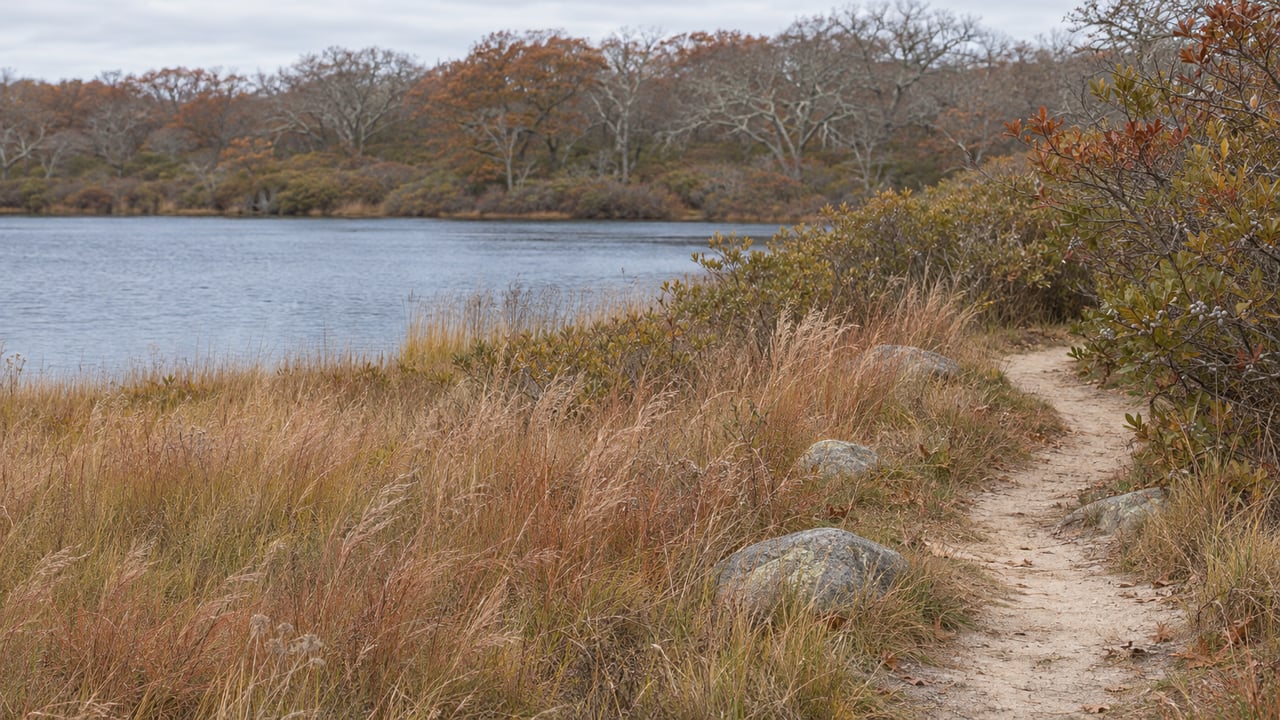
The fee pays for land in Chilmark, and much of it is open to the public:
- Waskosim's Rock Reservation, 191.2 acres of woodland, fields and wetlands, with remnants of a historic homestead and the boulder that gives the property its name.
- Fulling Mill Brook Preserve, 66.7 acres along the brook, with footbridges through the dense sections.
- Tea Lane Farm, 50 acres of working farmland with trails around and across the pastures, leased for crops, grazing and flowers.
- Quansoo Preserve, 5.8 acres with views of the pond and Town Cove, and a trail around the neighboring Quansoo Farm owned by Sheriff's Meadow Foundation.
- Squibnocket Pond Reservation, 335.7 acres held jointly with Sheriff's Meadow Foundation, with a south trail to a remote ocean beach.
Much of the money also pays for land the Land Bank has already bought. The Gazette reported that debt service is $9.6 million of the Land Bank's 2026 budget, or 68%. Executive director James Lengyel told the paper, "All of these sensational properties were not able to be purchased in cash." As a result, the 2% paid at a Chilmark closing this fall goes largely toward bonds issued for earlier acquisitions.
The Second 2% Has Been Delayed
Chilmark voters approved a second transfer fee years ago. In April 2022, they passed the Martha's Vineyard Housing Bank ballot question 257 to 69, as the Gazette reported. That proposal set a 2% fee, paid by the buyer, on the part of a sale price above $1 million. The fee needs authorization from the state legislature, and that has not happened.
The current bill, H.3193, would let towns set a rate between 0.5% and 2% above a $1 million threshold, paid by the purchaser. It received a favorable committee report on July 6, 2026, and was sent to House Ways and Means. The session ended at the end of July without action on any housing-bank or transfer-fee bill. "This is the end of the road for this session and we will have to try again in January," state Sen. Julian Cyr told the Gazette, which estimated it would likely be at least two years before a local transfer fee arrives. The MV Times reported that the Massachusetts Association of Realtors opposed the measure because of concerns about its effect on the housing market.
Supporters are planning another attempt. The Gazette reported that a May study by the UMass Donahue Institute, which looked at the Hamptons, found a fee would not meaningfully reduce Vineyard home sales and could raise $10 million a year for housing. John Abrams of the Coalition to Create the Martha's Vineyard Housing Bank told the paper, "We will get this through the legislature. We just don't know when." When the question went to town meetings in 2022, the Gazette reported that legislation cleared by the State House would return for a final vote at town meetings. The current bill likewise leaves adoption to a majority vote of each town's legislative body.
A Chilmark buyer who closes in 2026 pays the Land Bank fee alone. For a buyer with a longer timeline, the possible cost depends on rules that have not been written yet: the rate a town would choose, any threshold above $1 million, and the date the fee would start.
Frequently Asked Questions
Does the seller ever pay the Land Bank fee? The Land Bank collects the fee from the buyer at closing.
What happens if a buyer who used the first-time exemption sells early? If the property is transferred within five years, the exempted fee becomes due with interest and penalties, secured by a lien recorded with the deed.
Is a transfer into a family trust subject to the fee? The statute exempts transfers to a trust in exchange for a beneficial interest and distributions from a trust to its beneficiaries.
This post is general information, not legal, tax or financial advice. Whether a particular purchase qualifies for an exemption is a question to confirm with your attorney and with the Land Bank directly.
If you are budgeting for a Chilmark purchase or deciding when to close, Anson Realty can include the Land Bank fee in your numbers from the first showing. Request a private consultation.