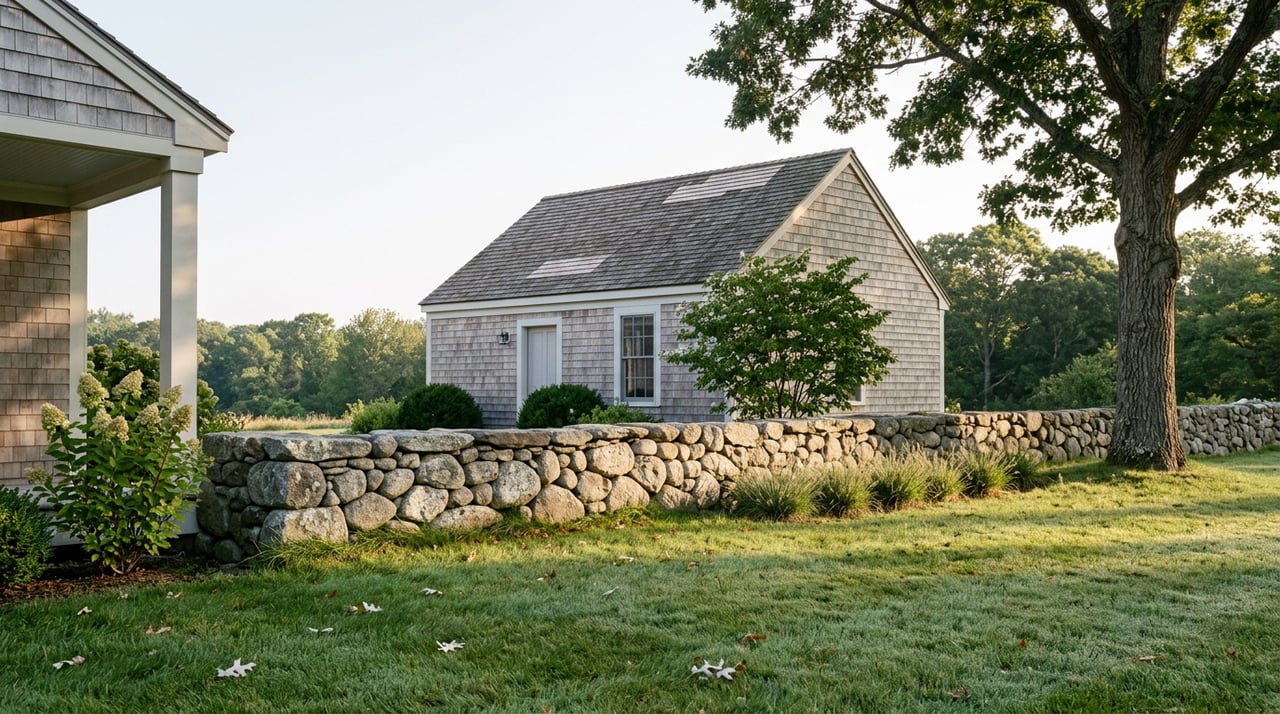
Search for the median home price in West Tisbury and the answer changes depending on which site you land on and when it last updated its numbers. One widely used tracker puts it at $4.2 million over the trailing three months heading into late summer 2026, up more than 125 percent from the same window a year earlier. A second source, pulling trailing twelve-month data as of spring 2026, shows $1,645,000, down 7 percent. A third, a smoothed home-value index measured around the same point in 2026, lands near $1,445,155, up a modest 1.5 percent. These are not typos or stale cache errors. They are three accurate readings of the same eleven-square-mile town, taken within months of each other, all correct.
That disagreement is not noise to filter out before you can understand West Tisbury. It is the clearest thing anyone can tell you about how this market actually works.
The Same Town, Three Different Answers
Here is what shows up if you check each source directly this year:
| Source | Time window | Reported figure | Year-over-year change |
|---|---|---|---|
| Median sale price tracker | Trailing 3 months, late summer 2026 | $4.2 million | up 125.9% |
| Median sale price tracker | Trailing 12 months, spring 2026 | $1,645,000 | down 7% |
| Smoothed home value index | Mid-2026 | $1,445,155 | up 1.5% |
| Median list price | June 2026 | $2.3 million | not reported |
Notice the pattern in that third row. The smoothed home value index barely moves while the raw sale-price trackers swing by more than a hundred percentage points in opposite directions within months of each other. That is not a coincidence. A home value index is built specifically to average out exactly the kind of volatility on display in the other three rows. When the smoothed number stays calm while the raw numbers convulse, the raw numbers are telling you about a handful of individual sales, not about the town.
Why the Median Breaks Here and Doesn't in Edgartown
A median only means something when enough transactions feed into it that no single sale can move the needle far. Edgartown and Oak Bluffs sell enough homes in a typical quarter that one large waterfront closing gets absorbed into the average. West Tisbury does not have that cushion, and the reason is written into its zoning.
The town's rural and village residential districts require a three-acre minimum lot size to build, a standard confirmed in the town's own zoning bylaw. Layer onto that the fact that more than 40 percent of the Vineyard's total conserved land sits within West Tisbury's borders, a disproportionate share for a single town. The Trustees of Reservations manage the 632-acre Long Point Wildlife Refuge on the south shore. Sheriff's Meadow Foundation holds roughly 436 acres at Cedar Tree Neck Sanctuary on the north side. The Martha's Vineyard Land Bank owns the Christiantown Woods Preserve. None of that acreage will ever generate a listing.
Then there is Seven Gates Farm, a historic planned community whose common land straddles West Tisbury and Chilmark. Roughly 930 acres of that common land was reclassified under Massachusetts General Law Chapter 61A and 61B for agricultural and recreational use, a status that lowers the annual property tax bill in exchange for keeping the land undeveloped. That kind of tax relief removes much of the financial pressure a large landholder would otherwise feel to sell, and the same 61A and 61B provisions remain on the books today for any qualifying agricultural or recreational parcel on the island.
Add up the acreage requirement, the conservation holdings, and the tax-favored farmland, and you get a town where the number of homes that trade in any given quarter is small enough that active listings alone span from roughly $1.4 million to $7.3 million depending on acreage and water access. A single closing at either end of that range, landing in a given three-month window, can drag the reported median in a different direction than the sale before it. That is exactly the pattern showing up in the table above.
The Vote That Also Complicates the Comparison
West Tisbury's zoning does more than limit how many lots exist. It also shapes what gets built on them, which matters if you are trying to compare price per square foot across towns.
At the 2022 annual town meeting, voters approved a bylaw restricting house size by a margin of 352 to 11, effective that June. The rule caps first- and second-floor living space at 3,500 square feet on a standard buildable lot. It sounds restrictive until you read the exemptions. Guest houses under 1,000 square feet do not count toward the cap. Neither do garages, pool houses, workshops, or accessory apartments. Basements can be fully finished. Add those pieces together on a compliant lot and you can reach roughly 8,800 square feet of usable space across a main house and its outbuildings, all while staying within the letter of the bylaw. You can read the Martha's Vineyard Times coverage of the vote for the full debate, and the town's bylaws are posted directly on the West Tisbury town website.
Why this matters for a buyer comparing towns on paper: the square footage listed on a West Tisbury property sheet may represent a fundamentally different mix of counted and exempt space than the same figure would mean in Chilmark or Edgartown, where the size rules are structured differently. A dollar-per-square-foot comparison across towns already assumes the square footage means the same thing everywhere. In West Tisbury, it often does not.
A Better Comparison Than the Median
If the headline median is unreliable, what should a buyer actually look at? Price per acre and price per bedroom hold up better here, because they are less sensitive to the exact mix of what closed last quarter. On that basis, West Tisbury tends to trade below neighboring Chilmark, even though both towns share the same up-island character of stone walls, working farms, and long dirt driveways. The trade-off buyers accept for that discount is typically less direct ocean frontage and a location that feels slightly less remote than Chilmark's outer reaches, since West Tisbury sits at the geographic center of the island rather than out toward its western edge.
That comparison, not the quarter's median, is the number worth building a strategy around.
What This Means If You're Shopping West Tisbury Right Now
Three things follow from all of this. First, treat any single median-price headline about West Tisbury with real skepticism until you know the transaction count behind it. A town this thin on annual sales does not generate the kind of stable statistic that towns like Edgartown produce every quarter. Second, ask specifically whether the acreage you are considering falls under the three-acre minimum for a standard buildable lot, and whether an existing structure was grandfathered before the 2022 size restriction took effect, since older homes built before that date are not required to conform. Third, when comparing offers or listings against other up-island towns, lean on price per acre and price per bedroom rather than the topline median or a simple price-per-square-foot figure, since the underlying zoning changes what that square footage represents from one town to the next.
Frequently Asked Questions
Does the 3,500-square-foot cap mean I can't build a large house in West Tisbury? No. The cap applies only to first- and second-floor living space in the main house. Guest houses under 1,000 square feet, garages, pool houses, workshops, and accessory apartments fall outside the limit, and finished basements do not count against it either. A compound built to the edges of those exemptions can reach roughly 8,800 square feet.
Why do different websites show such different median prices for the same town? Because West Tisbury's zoning and conservation footprint limit how many homes actually change hands each quarter. With a small transaction count, one large sale or one modest sale can shift a raw median by a wide margin, which is why trackers using different time windows can report figures that appear to contradict each other while all being accurate.
Is West Tisbury more or less expensive than Chilmark? On a per-acre and per-bedroom basis, West Tisbury has generally traded below Chilmark, in exchange for less direct ocean frontage and a location closer to the island's center rather than its western edge.
A market this thin on data rewards buyers who show up with someone who has watched actual closings here, not just the headline someone else's algorithm produced last week. Anson Realty works West Tisbury and the rest of up-island Martha's Vineyard directly, with the kind of on-the-ground read that a median price alone cannot give you. Request a private consultation to talk through what a specific parcel, lot, or listing actually means before you compare it to anything else on the island.